
Tabletop Assembly - Time, Yield, and Rework
Tabletop assembly lines operating with manual labor frequently suffer from high variance, hidden costs, and late-stage defect detection. When standard manufacturing time is documented at 60 minutes per unit but yields hover at 50% with an average rework time of 20 minutes, the actual unit build time increases to 80 minutes.
This guide breaks down the core structural failures of unsegmented manual assembly, detailing actionable manufacturing engineering practices—from tactile shop-floor planograms to adjacent feeder stations—that eliminate waste, improve yield, and lower standard cost.
1. The Financial Reality of Late-Stage Rework
Manufacturing standards often obscure true shop-floor costs. A line built around a documented 60-minute single-operator tabletop assembly may seem cost-effective on paper, but standard labor metrics fail to capture the financial drag of rework.
Key Cost Metrics
Documented Standard Labor: 60 minutes per unit.
First-Pass Yield (FPY): 50 percent.
Average Rework Time: 20 minutes per defective unit.
True Unit Production Time: ~80 minutes per completed unit.
When a 60-minute process runs as a single uninterrupted block of work, a critical assembly error occurring at Minute 5 remains hidden until final inspection at Minute 60. The 20-minute rework penalty, combined with scrap rate and material overhead, means the line operates at a 33% inflation over standard labor costs.
2. Implementing Tactile Checkpoints (Takt-Time Segmentation)
Unsegmented assembly blocks delay feedback loops. Segmenting an hour-long assembly into discrete, measurable cycles introduces early feedback, catching defects at the point of origin rather than at final inspection.
Pre-Shift Kitting Protocol
Standardize Tool and Part Placement: Build a physical planogram—analogous to a retail shelf layout—where every tool, bin, and fixture has an exact, labeled coordinate on the workbench.
Stage Daily Hardware Requirements: Kit each station before the shift starts with the exact quantity of components required for that day's demand.
Eliminate In-Process Material Retrieval: Ensure operators do not leave the work cell to restock hardware or retrieve specialized tooling during an active build.
Setting up a kitted, planogrammed station adds approximately 15 minutes of material-handler preparation before the shift. However, eliminating operator motion waste yields an immediate 10–12% gain in active build efficiency across the workstation.
4. Flow vs. Batching: Adjacent Feeder Subassemblies
Pre-building subassemblies in batches of 100 units days or weeks before final assembly introduces high inventory risk and hides systematic tooling errors.
Weekly Batching Method
Max Scrapped / Reworked Units Up to 100 units
Batch Size 100 units
Defect Exposure Window Days to Weeks
Work-in-Process (WIP) Holding High (Floorspace & Capital tied up)
Tooling Drift Detection Delayed until main assembly
Adjacent Feeder Station Method
Max Scrapped / Reworked Units1 Unit
Batch Size 1–5 units (Matched to Takt Time)
Defect Exposure Window Minutes
Work-in-Process (WIP) Holding Near Zero
Tooling Drift DetectionImmediate
Building Subassemblies In-Line
Relocate Subassembly Operations: Move subassembly fixtures directly adjacent to the main tabletop assembly station.
Synchronize Production Rates: Reconfigure the feeder station to build sub-components on-demand to match the main station’s takt time.
Establish Immediate Quality Verification: Inspect subassemblies at the feeder station before transferring them to the main build area.
If a assembly fixture drifts on Unit 3 of a 100-piece batch, Units 4 through 100 will contain the exact same hidden defect.
Moving subassemblies to an adjacent feeder station reduces the defect detection window from days of undetected errors down to 15 minutes and immediate correction.
5. Non-Confrontational Quality Escalation Processes
Technical fixes fail if the human process for reporting defects creates hostility, shame, or interpersonal conflict. A standardized escalation protocol removes emotion from quality reporting.
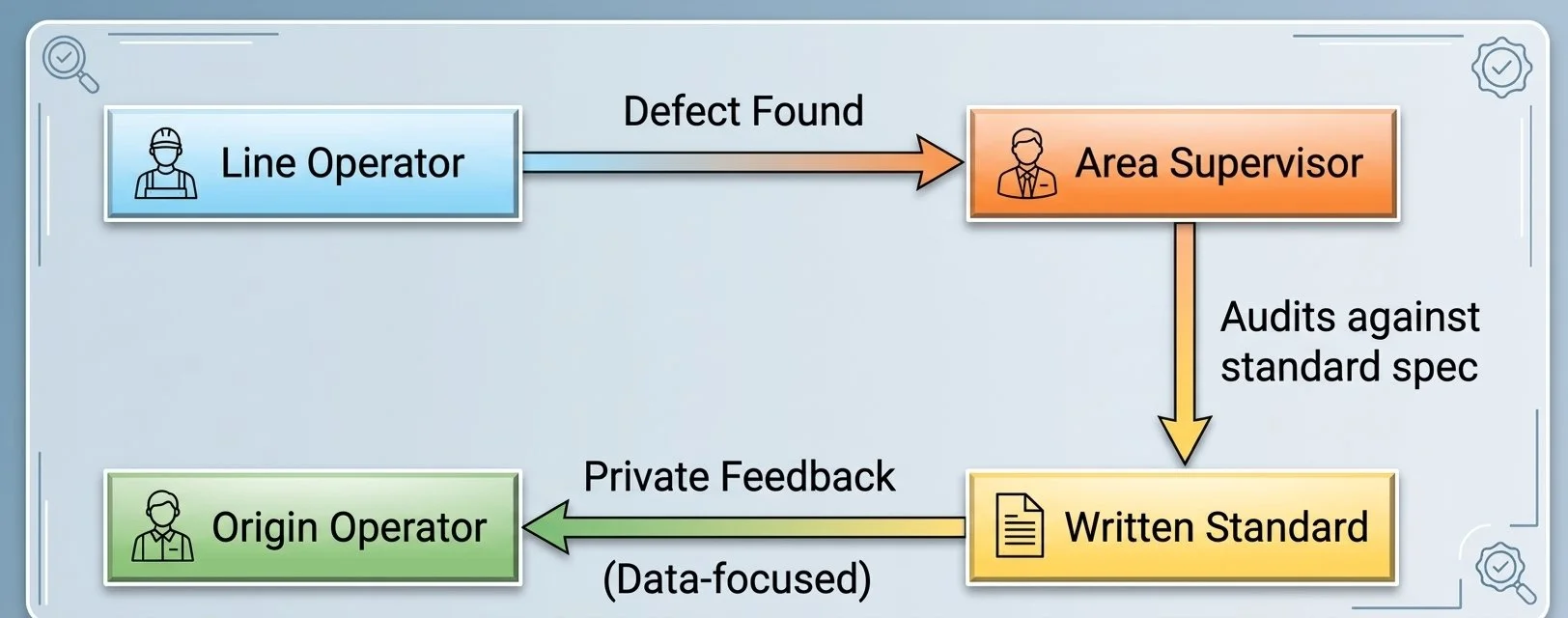
Respectful Systematic Defect Detection and Notification
Avoid weaponizing or retaliation by keeping it to the facts, with an impartial third party or supervisor when appropriate.
Standard Operating Procedure for Defect Escalation
Isolate the Operator-to-Operator Path: Line operators who discover a non-conformance do not directly contact or challenge the operator who built the component.
Notify Supervisory Lead: The discovering operator logs the non-conformance and alerts the area supervisor.
Audit Against the Engineering Standard: The supervisor verifies the non-conformance against written specifications and physical limits to eliminate subjective bias.
Conduct Private Corrective Discussion: If the assembly is defective, the supervisor addresses the operator who produced the work in private.
Maintain Objective Data Focus: Discussions focus exclusively on part dimensions, torque limits, and process steps—never personal performance or capability.
This protocol prevents informal "vigilante" feedback, retaliatory reporting, and toxic workplace dynamics, ensuring quality management remains an objective engineering function.
6. Managing Pride, Perfectionism, and Baseline Human Error
Even highly skilled manual assembly technicians operate with a baseline defect rate of 5% to 10%. Treating defects as personal failures damages transparency and leads operators to conceal rework.
Typical Skilled Manual Labor Error Distribution:
[ Baseline Skill & Precision: 90% - 95% Yield ] [ Natural Human Error: 5% - 10% Risk ]
Structural Factors in Workstation Quality Management
Acknowledge the Human Baseline: Skilled hand assembly carries an inherent 5% to 10% error margin due to fatigue, variance in raw materials, and cognitive load.
Separate Self-Worth from Work Products: Skilled operators often view mistakes as personal failures. Clear standards shift focus from operator competence to process capability.
Eliminate Cultural Barriers on Legacy Products: Long-established product lines often foster unconfrontational environments where quality control and production operators avoid reporting issues to keep the peace.
Shift from Execution Authority to Leadership in Thinking: Operations management must shift from command-and-control tactics ("I pay you, so do what I say") to psychological safety. Fear drives defect concealment; structured systems drive early exposure and resolution.
